
My boyfriend and I began our visit heading towards the Bikan Historical Quarter. Once across the main intersection in front of the station, we found ourselves wandering down a covered arcade lined with merchants selling traditional Japanese items. I found myself almost too afraid to breathe in one of these small stores, with every surface piled high with the most delicate-looking and beautiful ceramics and tableware I’ve ever seen. Every step was a conscious effort to be graceful and cautious as I exited before I accidentally did something bullish.
There were stores selling getas, traditional platform sandals, renting and selling long elaborate kimonos, and all the jeweled accessories you could dream of. There were also stores full of drinks, trinkets, and candies to take home for loved ones, a tradition known in Japan as omiyage. Turning out of the covered alley full of tempting treasures, we soon saw why the stores offered so many kinds of very historical and traditional clothing.
When the sun hit our eyes and we stepped out from under the awnings, the pavement fell away to a beaten-down earthen path, and we realized we had accidentally jumped into the past. Walls of plaster and Yakisugi (cedar, burnt to give it longevity) rose beside us. We began to see kura lining the earthen streets—old 17th-century storehouses that had been converted, with many private residences featuring lime plaster still sparkling as if it weren’t hundreds of years old.
Japanese tourists filled the streets, sometimes giving my boyfriend and I curious looks, since it seemed that most of the tourists visiting Kurashiki were Japanese nationals and we stuck out sorely with our different faces and western clothing. Many of the converted storehouses also housed little shops and storefronts for local artisans, filled to the brim with art and craftsmanship and even special little gaphachon, capsule vending machines, out front filled with Bikan exclusive souvenirs.
Whenever people ask me why I like Japanese products and the way Japanese artists make things, I always find myself reverently whispering a single word, “Kodawari.”—the pursuit of perfection. I am a self-proclaimed hater of those who describe themselves as “perfectionists,” because often they use it as an excuse to avoid a diagnosis and therapy or as a way to avoid accountability for appalling and unnecessary behaviors. Kodawari, however, the pursuit of perfection in what you are doing, to me, at least, speaks more of requiring perfection from yourself rather than others. It is the holy and sacred devotion of completely surrendering yourself to your craft.
The historical streets of Bikan whispered this word to me with every step and turn—from the beautiful wooden carvings of the old houses with sensual and shining curved roofs that had withstood the biting teeth of time, to the unimaginably intricate clothing being sold in the kura, to even the fragrant food being sold to tourists on the street, so many of them being prepared right in front of us with great care.
We twisted this way and that, exploring the tiny alleys until we found ourselves along a slow and sparkling river lined with willows. I decided immediately this must have been Momotaro’s birthplace. Shrieks of children filled the air as they used fallen branches to play fisherman; the enormous orange and white-dappled koi in the channel nibbled at their sticks, playing along. Long boats floated lazily down, steered by men in traditional wide sun hats, while tourists in their historical garments snapped photos and waved to those of us, smiling at them from the shore.
We were standing and waving to them when the fragrance of stewed meats and veggies wafted towards me, and our stomachs announced it was time to keep moving and seek out lunch. In a packed udon shop, I watched in awe as a young man pulled and separated the noodles behind a plexiglass window for us to watch while we slurped from our bowls.
With my bowl nearly empty and washed down with a wheaty and refreshing local lager, I approached the noodle master, shyly asking, “Shashin wa īdesu ka?” (“Are photos okay?”)
“Hai!” (“Yes!”) Delight quickly filled his face when he realized what I was asking, despite my American accent. With his bits of English and my Japanese, he began asking me about my reasons for visiting and explaining the process of making the noodles. After learning about kodawari, I’m sure none of you are surprised to find out that making a single batch of these noodles can take over 24 hours in total.
After our bowl, we digested by the riverside a bit more and grabbed another snack to continue making our way through the plaster alleyways and tiny stores of goods. Directing me down towards one side of the canal, I noticed an increasing number of clothing stores, specifically denim. Soon we found ourselves in a small area known as Denim Alley, where almost every shop was filled to the brim with all different types of items I didn’t even realize could come in denim. There were typical jeans, most of which were handmade, with most stores offering fittings and alterations, as well as shirts, blouses, jackets and even more unexpected denim items like hair bows, coin pouches, kimonos, and even roses made out of blue jeans.
My boyfriend was in heaven, and I sat down on a bench decorated with roses while I happily enjoyed a “Denim” ice cream cone—an enchanting indigo shade with a sweet and creamy blueberry flavor. I was a bit confused since we had been to almost four different stores selling pants, but none of them seemed to be the ones he was looking for.
It turned out our journey into Kurashiki was not over, for Momotaro resided in the Kojima district— a holy place of denim enthusiasts and home to some of the world’s most famous makers of jeans. We hopped on the bus, and a fiery sunset painted Kurashiki’s bustling industrial parks as the near-empty bus chugged down the narrow highway. Soon our view was filled with lush trees and twilight’s glow turned Kurashiki’s rural forests emerald green, sparkling and winking from the streetlights.
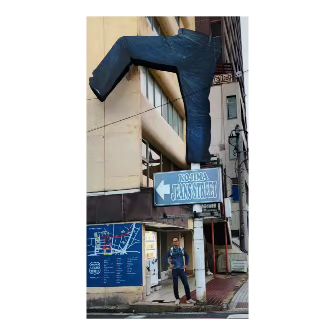
The sun was low when we hopped off the bus and were greeted by the biggest pair of pants I had ever seen. A whole street dyed in indigo, painted blue, and even more stores selling denim than in Bikan. These stores were much larger, and many were where they were actually making the jeans or had machinery on display for customers to see.
Crickets began singing to us as we made our way down the blue streets, with darkness having now fallen. A warm golden glow from a storefront filled our eyes, and we were relieved to see we had made it just in time before closing. Polished warm wood filled every inch of Momotaro, and the attendant who was most confident in her English approached us to help. Japanese customer service, as a whole, is incredible, and I’m often taken aback by how kind and patient they are with their customers. Our clerk in Momotaro was no exception. Despite being so close to closing, she happily showed my boyfriend different pieces, suggesting various colors and sizes, and sharing pieces of her life with me in the bit of Japanese that I speak.
In the back of the shop, giant, incredible looms sat where they still hand-make things. Each piece is made with cotton imported from Zimbabwe, giving it both durability and softness, and is dyed with a natural indigo called Tokuno Blue, which has been used for dyeing since ancient times in Japan.
With our arms laden with bags of treasures as if we had just defeated a demon king, my boyfriend and I happily made our way back towards the quiet trains that would spirit us back to Osaka.
This blue buttondown was agift from my boyfriend on our trip to Momotaro and I must say it’s one of the comfiest shirts I’ve ever worn. Let me know if any of you have tried out their clothing! I know I’ll definitely be interested in adding more pieces from them into my wardrobe.








 Planetary Anecdotes
Leave a comment